
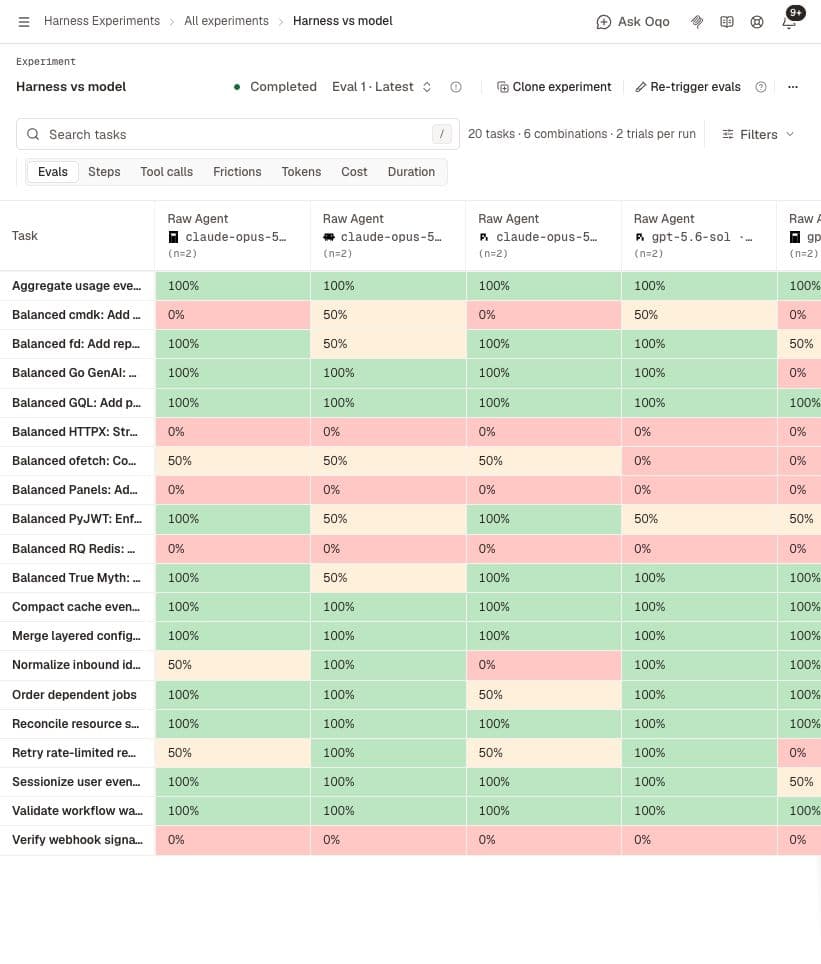
Why does GitHub Copilot running Opus-class models still feel meaningfully different from Claude Code on the same models? Why has Cursor built strong loyalty when it shares the same editor base and model APIs as other tools (except for their in-house Composer models)?
The difference isn’t the model. It’s the harness - the surrounding system that manages context, tool execution, feedback loops, and recovery. Run the same model across different agent setups on real tasks - we've tried this with copilot and claude code. The output quality gap appears immediately and a detailed trajectory analysis tells you all the bad decisions taken on the way.
A frontier model on a weak harness is still held back by its environment. A capable but non-frontier model on a strong harness often produces more reliable results because the harness reduces the space where the agent has to improvise or recover on its own.
The industry’s measurement systems and attention are still heavily oriented toward models. Major benchmarks are designed to hold the harness fixed or minimize its contribution so the model can be evaluated in isolation. This is useful for model comparisons, but it has left us with mature ways to score models on standardized harnesses and almost no equivalent infrastructure for evaluating harnesses on fixed models.
As a result, we continue to optimize and celebrate improvements in the layer that’s easiest to benchmark while under-investing in the layer that frequently determines whether agents complete work reliably in practice.